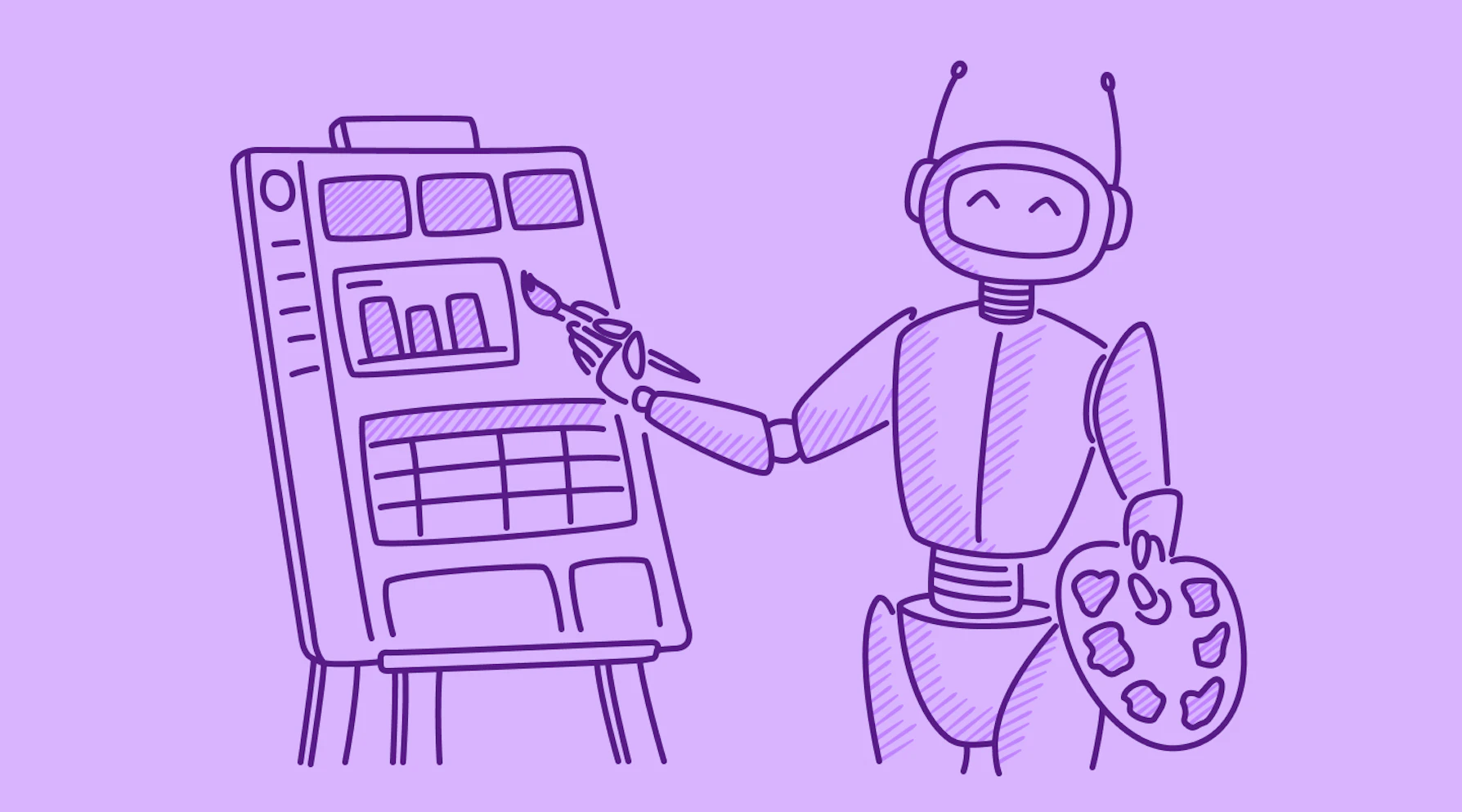
AI can write code now. That part is no longer debatable. You can describe an app in a paragraph and watch working code appear on screen in seconds. It's fast, it's impressive, and it's genuinely useful.
But speed and usefulness aren't the same thing as quality. The apps that survive past the prototype stage, the ones that real people rely on, that other developers can maintain, those require more than just prompting a model and shipping whatever comes out. They require thinking.
This guide covers the full process of building an app with AI in 2026, from the first idea to a deployed product. Not just the "how to prompt" part, but the parts that actually determine whether your app is something people can use, read, and fix six months from now.
Start with the Idea, Not the Tool
This sounds obvious, but in 2026 it needs saying: don't start with the AI tool. Start with the problem.
It's tempting to open your favorite AI editor, type "build me a project management app," and see what happens. You'll get something. It might even look good. But if you haven't thought through what the app actually needs to do, who it's for, and how it fits into existing workflows, you're going to spend more time reworking AI output than you would have spent planning.
Before you write a single prompt, answer these:
- What specific problem does this app solve?
- Who are the users, and what does their typical workflow look like?
- What data does the app need to handle? Where does it come from?
- What are the must-have features vs. the nice-to-haves?
- Are there compliance or security requirements (RBAC, audit trails, data privacy)?
You don't need a formal spec. A few paragraphs in a notes app will do. The point is to have something concrete to guide the AI, because the better your input, the better its output.
Pick the Right Type of AI Tool for Your Project
Not all AI development tools work the same way, and choosing the wrong one for your project type is a common early mistake. In 2026, the landscape roughly breaks down into three categories:
Prompt-to-app platforms let you describe an application in natural language and get a working result without writing code. These are ideal for prototypes, quick validations, and simple tools. The trade-off is limited control over the code structure and architecture.
AI-native editors (like Cursor) integrate AI into a traditional coding workflow. You write code, but the AI assists with completions, refactors, and multi-file changes. This gives you full control but requires development experience.
Domain-specific AI tools understand a particular type of application and generate code that follows established patterns. Refine, for example, is built specifically for internal tools, admin panels, and CRUD-heavy applications. Instead of generating generic React code, it produces structured applications using battle-tested libraries like TanStack Query and established UI frameworks. The generated code follows real architectural patterns because the AI understands the domain.
The right choice depends on your project. Building a quick prototype to test an idea? A prompt-to-app platform might be enough. Building something that needs to last? You want a tool that produces code you can actually maintain.
Define Your Architecture Before You Prompt
Here's where a lot of AI-built apps go wrong. People start generating code immediately and end up with a Frankenstein codebase, dozens of files with no consistent structure, mixed patterns, duplicated logic, and components that only make sense to the model that wrote them.
AI is great at generating individual pieces. It's much worse at maintaining coherent architecture across an entire project. That's your job.
Before you start generating, decide on:
- Framework and language. React? Next.js? Python with FastAPI? Pick one and stick with it.
- Project structure. Where do components live? How are routes organized? Where does business logic go?
- State management approach. Are you using a server-state library like TanStack Query, or client-side state with Zustand or Redux?
- API patterns. REST or GraphQL? How are endpoints structured? How is authentication handled?
- Naming conventions. This sounds minor but it matters. If the AI generates
getUserDatain one file andfetchUserInfoin another, your codebase gets confusing fast.
Write these decisions down. When you prompt the AI, include them as context. Most modern AI tools let you set project-level instructions that persist across conversations. Use them.
Build Incrementally, Not All at Once
The single biggest mistake people make with AI development is trying to generate the entire app in one go. Even the best models lose coherence over long generations. You end up with code that contradicts itself, features that half-work, and a mess that's harder to debug than code you wrote yourself.
Instead, build in small, verifiable steps:
- Start with the data model. Define your entities, their relationships, and your API layer. Get this right first, because everything else depends on it.
- Build one feature end-to-end. Pick the core feature, get it working from database to UI, and make sure the pattern is solid before you replicate it.
- Expand feature by feature. Use the first feature as a reference. Tell the AI "follow the same pattern as the users module" when building the next one.
- Add cross-cutting concerns last. Authentication, authorization, error handling, logging. These touch everything, so they're easier to add once the structure is stable.
Each step should produce working code that you've tested. Don't move to step 2 until step 1 actually works. This sounds like standard software development advice, and it is. AI doesn't change the fundamentals, it just changes the speed at which you move through them.
Read the Code. Every Time.
This is the most important section in this guide.
AI-generated code is not inherently good or bad. It's code. And like all code, it needs to be read, understood, and verified by a human before it goes anywhere near production. The fact that a machine wrote it doesn't make it correct, and the fact that it runs doesn't mean it's right.
Here's what to look for when reviewing AI output:
Does it actually do what you asked? Models are confident. They'll generate something that looks plausible even when it doesn't match your requirements. Test the output against your actual use case, not just whether it compiles.
Is it readable? If another developer (or future you) can't understand what the code does by reading it, it needs to be rewritten. AI tends to produce verbose, over-engineered solutions. Simplify where you can.
Are there security issues? AI models don't think about security the way an experienced developer does. Watch for hardcoded secrets, missing input validation, SQL injection vectors, improper authentication checks, and overly permissive CORS configs. We've written about this in the context of internal tools development, where RBAC and audit logging are non-negotiable.
Does it handle edge cases? AI code tends to handle the happy path well and fall apart on edge cases. What happens when the API returns an error? When the user submits an empty form? When the session expires mid-operation?
Is it consistent with the rest of the codebase? AI doesn't always remember the patterns established in earlier parts of the project. A function that uses async/await in one file and callbacks in another is a red flag.
The goal isn't to distrust AI. It's to treat AI-generated code with the same rigor you'd apply to code from a junior developer on your team. You wouldn't merge a pull request without reviewing it just because the person seemed confident. Same principle applies here.
Human Supervision Is Not Optional
There's a narrative floating around that AI will eventually make human developers unnecessary. That's not where things stand in 2026, and it's a dangerous mindset to adopt right now.
AI tools are remarkably good at pattern matching and code generation. They are not good at:
- Understanding business context. The model doesn't know that your healthcare app has HIPAA requirements, or that your fintech product needs PCI compliance, unless you tell it. And even then, it might miss the implications.
- Making architectural trade-offs. Should you optimize for read speed or write speed? Should you denormalize this table? These decisions require understanding the actual usage patterns of your app, something a model can't observe.
- Catching subtle bugs. AI can produce code that passes all your tests and still has a logic error that only surfaces in production under specific conditions. This happens with human-written code too, which is exactly the point, AI code needs the same level of scrutiny.
- Knowing when to stop. AI will keep generating if you keep asking. It won't tell you "this feature is unnecessary" or "this adds complexity without value." That judgment call is on you.
The developers building the best apps with AI in 2026 aren't the ones who prompt the most. They're the ones who think the most. They use AI to move faster through the mechanical parts of development, writing boilerplate, generating implementations of well-understood patterns, scaffolding tests, and then apply their own judgment to everything the AI produces.
Testing AI-Generated Code
Testing is where a lot of AI-built projects fall apart. The code works in the demo. It looks good in the screenshot. Then real users show up and things break in ways nobody anticipated.
AI can actually help with testing, and you should use it for that. But the testing strategy still needs to come from you.
Unit tests. Ask the AI to generate tests for the code it wrote. Then read those tests carefully. AI-generated tests have a tendency to test implementation details rather than behavior, or to write tests that are tautological (they pass because they're testing what the code does, not what it should do).
Integration tests. These are harder for AI to generate well because they require understanding how different parts of the system interact. Write these yourself, or at minimum, heavily guide the AI with specific scenarios.
Manual testing. There's no substitute for actually using the app. Click through every flow. Try to break it. Enter unexpected data. Use it on mobile. The things you catch manually are often the things that matter most to real users.
Security testing. Run your code through static analysis tools. Check for the OWASP Top 10 vulnerabilities. AI-generated code is as susceptible to these as human-written code, sometimes more so, because models learn from public repositories that contain plenty of insecure patterns.
Deployment and the Real World
Getting an AI-built app to work locally is the easy part. Getting it to work reliably in production is where the real engineering happens.
A few things that AI tools typically don't handle well:
- Environment configuration. API keys, database connection strings, environment-specific settings. Make sure these are properly externalized, not hardcoded in the generated code.
- Error monitoring. AI won't set up Sentry or Datadog for you. But you need observability in production, because when things break (and they will), you need to know about it before your users tell you.
- Performance at scale. Code that works fine with 10 users might fall over at 1,000. Database queries that are acceptable with 100 rows become problems with 100,000. AI tools generally don't optimize for this unless you explicitly ask.
- CI/CD pipelines. Automated testing, linting, and deployment pipelines are critical. AI can help generate GitHub Actions or similar workflow configs, but you need to verify they actually work and cover the right scenarios.
The apps that make it past the prototype stage are the ones where someone took the time to think about these operational concerns. AI handles the code generation; you handle the engineering.
A Practical Workflow
Pulling all of this together, here's a workflow that works well in 2026:
- Plan. Write down what you're building, for whom, and why. Define your architecture, tech stack, and core data model.
- Set up the project. Initialize your repo, configure your AI tool with project-level instructions, and set up basic infrastructure (linting, formatting, type checking).
- Build the foundation. Generate your data models, API routes, and authentication layer. Review everything carefully.
- Build feature by feature. One at a time, end-to-end. Test each feature before moving to the next.
- Review and refactor. After every few features, step back and look at the codebase as a whole. Is it consistent? Are there patterns that should be extracted? Is the AI drifting from your conventions?
- Test thoroughly. Unit, integration, and manual. Don't skip any of these.
- Deploy and monitor. Set up proper deployment pipelines and observability. Watch how the app behaves with real users.
- Iterate. Fix what breaks, improve what's awkward, and repeat.
This isn't that different from how you'd build an app without AI. The difference is speed. Steps that used to take days now take hours. But the thinking, the planning, and the review still take the same amount of time, and rightly so.
What Actually Makes AI-Built Apps Succeed
After watching hundreds of AI-built projects launch (and fail) over the past year, a few patterns stand out.
The successful ones have clear ownership. Someone understands the entire codebase, can debug it without AI assistance, and makes deliberate architectural decisions. The AI is a tool, not the architect.
The successful ones produce readable code. If you can't explain what a function does to a colleague, it doesn't matter that the AI generated it in 2 seconds. Rewrite it until it's clear.
The successful ones treat AI output as a first draft. Just like you'd edit a first draft of a document, you edit AI-generated code. Remove the unnecessary complexity. Rename the variables. Delete the dead code. Make it yours.
The failed ones usually share the same story: someone generated a bunch of code, didn't read it carefully, shipped it, and then couldn't fix it when something went wrong. The AI gave them speed but they skipped the understanding, and without understanding, speed is just a way to create problems faster.
Wrapping Up
AI is genuinely the biggest shift in how software gets built since the move to open source frameworks. The tools are powerful, they're getting better quickly, and they make it possible for smaller teams to build things that used to require much larger ones.
But the fundamentals haven't changed. Good software still requires clear thinking about the problem, deliberate architectural decisions, thorough testing, and code that humans can read and maintain. AI accelerates the parts of development that were always mechanical, the boilerplate, the scaffolding, the repetitive patterns. It doesn't replace the parts that require judgment.
The developers who are building the best apps with AI right now aren't the fastest prompters. They're the ones who know when to let the AI generate and when to stop, read, think, and rewrite. They treat AI like a very fast collaborator who needs supervision, not like an oracle who always gets it right.
If you're building internal tools, admin panels, or data-heavy applications, tools like Refine combine AI-powered generation with established open source patterns, so you get speed without sacrificing code quality or ownership. That's the sweet spot in 2026: fast enough to ship, solid enough to maintain.
Use AI to build faster. Use your brain to build better. That's the whole guide.
Frequently Asked Questions
Can a non-developer build a production app with AI?
For simple applications, yes. Prompt-to-app platforms have made it possible to build basic tools without writing code. But for anything beyond a prototype, someone with development experience should be involved, at least for reviewing architecture, handling security, and managing deployment. The "no code needed" pitch is partially true for simple cases and misleading for complex ones.
How much of the code should I let AI generate vs. write myself?
There's no universal ratio. A reasonable approach: let AI handle boilerplate, repetitive patterns, and well-understood features (CRUD operations, form validation, API endpoints). Write the business logic, security-critical code, and architecturally significant pieces yourself. The key isn't what percentage AI wrote, it's whether you understand and can maintain every line in the codebase.
Is AI-generated code secure?
Not by default. AI models learn from public code, which includes plenty of insecure patterns. Always review generated code for common vulnerabilities: hardcoded secrets, missing input validation, SQL injection, insecure authentication flows. Use static analysis tools and follow the same security practices you'd apply to human-written code.
Will AI-generated code become harder to maintain over time?
It can, if you're not careful. The risk is ending up with a codebase where different parts follow different patterns because they were generated in separate sessions without consistent context. The fix is having clear architectural conventions, reviewing generated code for consistency, and refactoring regularly, the same practices that keep any codebase maintainable.
Should I mention that my app was built with AI?
That's a business decision, not a technical one. Users care about whether the app works, is reliable, and solves their problem. How it was built is usually irrelevant to them. Different story for investors or enterprise buyers who may ask about your development process and code ownership.