
A year ago, most developers hadn't heard the phrase "vibe coding." Today it's on conference stages, in job descriptions, and at the center of a real debate about how software gets built. The term went from a casual tweet to a genuine shift in how people think about writing code.
This post covers what vibe coding actually is, how the tooling landscape has evolved, where the approach works well, where it falls apart, and what it means for developers and non-developers heading into 2026.
Where the Term Came From
In February 2025, Andrej Karpathy (former head of AI at Tesla, co-founder of OpenAI) posted a tweet that gave the idea its name:
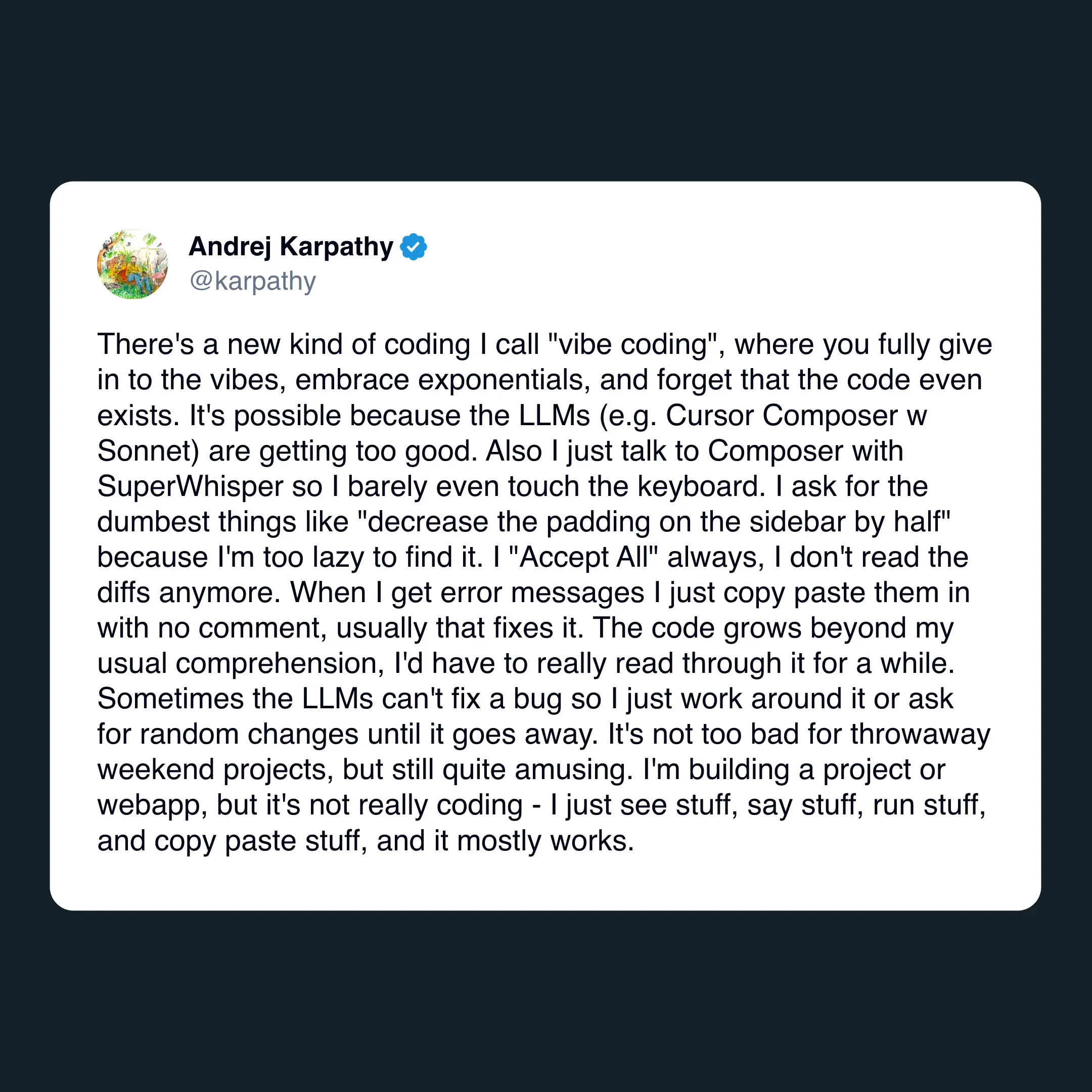 Screenshot of the tweet of Andrej Karpathy
That tweet resonated because it described something many developers were already doing but hadn't named. You open an AI tool, describe what you want in plain English, and let the model generate the code. You don't read every line. You don't plan the architecture upfront. You just see if it works, adjust your prompt, and keep going.
Karpathy wasn't proposing a methodology. He was describing a feeling, the experience of building software by intent rather than by instruction. The name stuck because it captured that shift perfectly.
How We Got Here
Vibe coding didn't appear out of nowhere. It's the result of AI tooling improving rapidly over the past few years, each step lowering the bar for what you needed to know before you could build something.
2021-2022: Autocomplete gets smart. The first AI coding assistants launched and gave developers inline suggestions as they typed. Impressive, but limited, mostly finishing lines or generating boilerplate functions. You still needed to know what you were doing.
2023: Chat enters the editor. Large language models changed expectations. Developers started pasting code into chat windows, asking for explanations, requesting refactors. A new generation of AI-native editors emerged, building entire workflows around chat interfaces that could read your whole codebase.
2024: Agents take the wheel. The jump from "suggest code" to "write the whole feature" happened fast. Prompt-to-app platforms let users describe an application in a sentence and get a working frontend in seconds. Others went further, generating full-stack applications with databases and deployment from a single conversation.
2025-2026: The lines blur. AI editors added agent modes that can plan multi-file changes, run commands, and iterate on errors autonomously. The distinction between "AI-assisted coding" and "AI-generated applications" is no longer clear-cut. It's a spectrum, and vibe coding lives across all of it.
The Spectrum of Vibe Coding
One of the common misconceptions is that vibe coding means "not writing any code at all." In practice, it's more of a spectrum. Where you land on it depends on your experience, your project, and your tools.
Full vibe, no code review. You describe what you want, accept what the AI gives you, and move on. This is closest to Karpathy's original description. It works for throwaway prototypes, personal experiments, and projects where correctness isn't critical. Non-technical founders use this approach with prompt-to-app tools to validate ideas before hiring a team.
Guided vibe, light editing. You prompt the AI, review the output at a high level, make small adjustments, and iterate through conversation. Most developers doing "vibe coding" in their day-to-day work are here. You're not reading every line of generated code, but you're steering the direction and catching obvious issues.
Structured vibe, heavy editing. You use AI to accelerate specific parts of development, generating components, writing tests, scaffolding API routes, but you own the architecture and review the code carefully. This is how experienced developers tend to adopt AI tools in production codebases.
The label "vibe coding" gets applied to all three, which is part of why the conversation around it can feel confused. Someone building a quick prototype with a prompt-to-app tool and a senior engineer using an AI editor's agent mode on a production codebase are both "vibe coding" in some sense, but the risk profiles are completely different.
The Tools Landscape in 2026
The ecosystem has matured significantly since the term was coined. Here's where the major categories stand:
Prompt-to-App Platforms
These let you describe an application and get a working result without touching code. They're the purest expression of vibe coding. You type what you want, and the tool generates a working frontend, sometimes a full stack, ready to run in your browser. The barrier to entry is essentially zero, which is what makes this category so compelling for non-technical founders and rapid prototypers.
AI-Native Editors
These integrate AI deeply into the development workflow, aimed at developers who want to write code faster rather than skip it entirely. They started as smart autocomplete but have grown into agent-based workflows that can read your entire codebase, plan multi-file changes, and execute them with minimal prompting. Developers who were comfortable writing code before still live here, but the nature of what they're doing has changed.
Domain-Specific AI Tools
This is the category that's growing fastest. Instead of generating generic code, these tools understand a specific domain and generate code that follows established patterns.
Purpose-built AI agents, like what Refine is building for internal tools, represent this direction. Instead of producing generic React code that you'll need to restructure, a domain-aware agent generates code that already follows the right architecture, uses the right libraries, and handles concerns like authentication, access control, and data fetching in a consistent way. We wrote about this in detail in our post on Purpose-Built AI Agents.
When Vibe Coding Works
Vibe coding isn't universally good or bad. It's a tool, and like any tool, it works well in certain contexts.
Prototyping and idea validation. This is the sweet spot. You have a half-formed idea, you want to see if it has legs, and you don't want to spend a week on setup before you find out. Vibe coding gets you to a working prototype in minutes. That's genuinely transformative for founders, designers, and product managers who previously had to wait weeks for even a rough implementation.
Internal tools and admin panels. CRUD interfaces, dashboards, data tables, form builders, these are well-understood patterns that AI can generate reliably. The code doesn't need to be perfect because the user base is small and internal. Speed of delivery matters more than pixel-perfect polish.
Learning and exploration. If you're picking up a new framework or library, vibe coding is an excellent way to learn by doing. You describe what you want, see how the AI implements it, and learn the patterns by reading and modifying the output. It's faster than reading docs and more hands-on than watching tutorials.
Hackathons and side projects. When the goal is "ship something by Sunday," vibe coding removes the friction that usually kills weekend projects. You skip the setup, skip the boilerplate, and get to the interesting part of building.
When Vibe Coding Falls Apart
The problems don't show up immediately. They accumulate.
Scaling past the prototype. The code that got you to a working demo is rarely the code you want to maintain for six months. AI-generated code tends to be flat, repetitive, and loosely structured. It works, but it doesn't compose well. Once you need to add features, refactor, or onboard another developer, the lack of architecture becomes a real cost.
Security and data handling. AI models generate code that works, not code that's secure by default. API keys end up hardcoded. Input validation gets skipped. Auth flows have subtle gaps. For anything touching real user data, you need someone who understands security reviewing the output, not just accepting it.
Complex business logic. AI is excellent at generating CRUD operations and UI layouts. It struggles with nuanced business rules, multi-step workflows, and edge cases that require domain knowledge. The more specific your requirements, the more you'll find yourself rewriting rather than prompting.
Debugging AI-generated code. This is the sleeper issue. When something breaks in code you wrote, you have mental context for why it was written that way. When something breaks in code an AI wrote, you're reverse-engineering someone else's decisions. Stack Overflow's 2025 Developer Survey found that 45% of developers say debugging AI-generated code takes longer than expected.
The maintenance trap. Your first prompt produces a working app. Your tenth prompt produces a tangled mess of patches on top of patches. Without a clear architecture guiding the AI, each iteration adds complexity without structure. Eventually, you spend more time fighting the codebase than building features.
Tips for Better Vibe Coding
Whether you're going full-vibe or using AI as an accelerator, a few practices make a big difference.
Be specific in your prompts. "Build me a dashboard" produces generic output. "Build a dashboard showing monthly revenue, active users, and churn rate, using a sidebar layout with date range filters" gives the AI enough context to generate something useful. The quality of the output is directly tied to the quality of the input.
Work in small increments. Don't try to generate an entire application in one prompt. Build feature by feature, testing each piece before moving on. This keeps the AI's context focused and makes it easier to catch issues early.
Use checkpoints aggressively. Version control isn't optional when you're vibe coding. Commit after every working state. When a prompt takes your codebase in the wrong direction (and it will), you want to be able to roll back cleanly instead of trying to untangle the damage.
Know when to stop vibing. The moment you find yourself fighting the AI's output more than building on it, it's time to switch modes. Read the code, understand the structure, and make deliberate architectural decisions. The best results come from knowing when to let the AI lead and when to take the wheel back.
Pick the right tool for the job. A prompt-to-app platform is great for a prototype. An AI-native editor is better for production code. A domain-specific tool is best when you know exactly what kind of application you're building. Matching the tool to the task saves hours of wrestling with output that doesn't fit.
Vibe Coding and Production Software
Here's the uncomfortable truth: most vibe-coded projects that succeed long-term eventually stop being vibe-coded.
The prototype gets built with vibes. The production version gets built with engineering. The value of vibe coding is in collapsing the distance between "idea" and "working thing." The value of engineering is in making that working thing reliable, maintainable, and secure.
The smartest teams treat vibe coding as the first phase, not the whole process. They use AI to explore ideas quickly, validate approaches, and generate initial implementations. Then they bring in structure, review the code, establish patterns, and build something they can maintain.
This is also where tools that understand your domain make a real difference. A generic AI tool gives you code that works. A purpose-built tool gives you code that works and follows patterns your team can maintain. The gap between those two outcomes is the gap between a prototype and a product.
For internal tools specifically, frameworks like Refine bridge this gap by providing AI-powered generation that already follows established architectural patterns, so the code you get from the "vibe" phase is closer to what you'd want in production. You skip the painful "now let's actually restructure everything" phase because the output was structured from the start.
Where This Is All Headed
A year into the vibe coding era, a few trends are becoming clear.
The tools are converging. Prompt-to-app platforms are adding more developer controls. AI editors are adding more autonomous agent capabilities. The line between "no-code AI app builder" and "AI-powered IDE" is getting thinner every month.
Domain expertise is the differentiator. Generic code generation is becoming commoditized. The tools that win long-term will be the ones that understand specific domains, whether that's internal tools, e-commerce, data pipelines, or mobile apps, and generate code that reflects real best practices in those areas.
Code quality is catching up. Early vibe coding was about speed at all costs. The next phase is about speed and quality. AI models are getting better at generating well-structured, maintainable code, and the tooling around them (linting, testing, review) is catching up.
The skill that matters is judgment. Knowing how to prompt an AI is useful. Knowing when to trust the output, when to rewrite it, and when to throw it away, that's the skill that separates developers who use AI effectively from those who end up buried in AI-generated technical debt.
Vibe coding isn't going away. If anything, it's becoming normal. But the meaning of the term is shifting. It's less about "forget the code even exists" and more about "let AI handle the parts that don't require your judgment, so you can focus on the parts that do."
FAQ
Is vibe coding only for non-developers?
No. The term originated in a developer context, and most people doing vibe coding today are developers using AI to move faster. Non-developers use prompt-to-app platforms to build without coding knowledge, but experienced developers also "vibe code" when prototyping, exploring, or accelerating repetitive work.
Can you build production software with vibe coding?
You can build a production-quality prototype with vibe coding. Shipping it to real users typically requires additional engineering: code review, security audits, architecture decisions, testing, and performance optimization. Some domain-specific tools narrow this gap by generating code that's already structured for production use.
What's the difference between vibe coding and AI-assisted coding?
It's a spectrum. Using an AI editor for inline autocomplete while you write code is AI-assisted development. Using an agent mode to generate entire features from a description is closer to vibe coding. The distinction is about how much you're steering versus how much you're delegating.
Is vibe coding safe for applications that handle sensitive data?
Not without additional precautions. AI-generated code can introduce security vulnerabilities, from hardcoded secrets to missing input validation. Any application handling user data, financial information, or PII should have its AI-generated code reviewed by someone with security expertise, regardless of how it was generated.
Will vibe coding replace traditional software development?
It's not replacing it, it's reshaping it. The fundamentals of software engineering, architecture, testing, security, performance, still matter. What's changing is how much of the routine implementation work gets delegated to AI. Developers who understand both the engineering fundamentals and how to work effectively with AI tools are in the strongest position.
How do I get started with vibe coding?
Pick a small project and a tool that matches your experience level. If you're non-technical, start with a prompt-to-app platform, describe your idea in plain language, and see what you get. If you're a developer, enable agent mode in whichever AI editor you already use and try generating a full feature from a description. Start with something low-stakes, a personal tool, a prototype, a side project, and work your way up as you learn what AI handles well and where you need to step in.