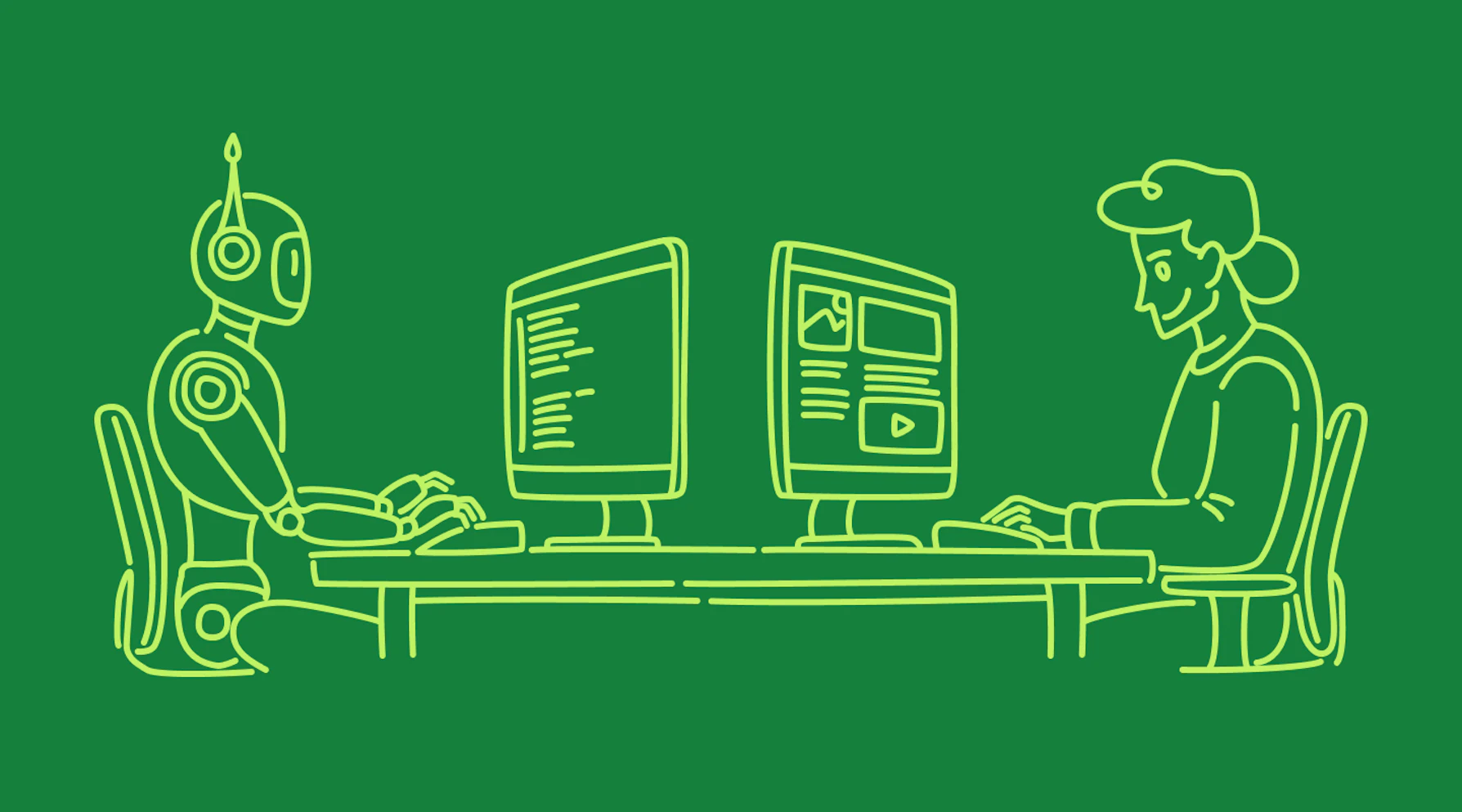
According to Stack Overflow's 2025 Developer Survey, 78% of developers say AI makes them more productive. Yet a 2025 randomized controlled trial found tasks took 19% longer when developers used AI assistants. Both findings are valid.
The gap between how productive we feel and how productive we are sits at the heart of the AI pair programming debate. Developers report saving hours per week with tools like GitHub Copilot and Cursor. But when researchers measure end-to-end delivery, the gains often disappear into extra debugging and review time.
Meanwhile, traditional pair programming, two developers at one keyboard, is still practiced at companies like Shopify and Pivotal. It's slower and more expensive on paper. It also catches bugs earlier, transfers knowledge both ways, and produces developers who actually understand the code they ship.
So which approach wins? The answer depends on what you're optimizing for.
What Traditional Pair Programming Actually Looks Like
Before we compare, let's be clear about what we're comparing to.
Traditional pair programming puts two developers at one workstation (or shared screen). One person drives, controlling the keyboard and writing code. The other navigates, reviewing each line as it's typed, thinking about design, and catching issues before they become problems. They switch roles every 15-30 minutes.
The benefits are well-documented. A 2024 study on knowledge-based team composition found that students in paired groups scored higher on programming assignments and final exams than students working solo. Pairs produced better-quality code. More importantly, both people walk away understanding the code, which reduces the "hit by a bus" risk that plagues teams with siloed knowledge.
The drawbacks are equally real. Two developers working on one task looks expensive to managers who see two salaries producing one output. Constant collaboration is mentally exhausting. Bad pairings, whether due to personality clashes or skill mismatches, can make both developers miserable.
Research from 2020-2026 suggests pair programming works best for complex tasks with well-matched pairs. For simple, repetitive work, the overhead often isn't worth it.
How AI Pair Programming Works
AI pair programming tools like GitHub Copilot, Cursor, Amazon CodeWhisperer, and Codeium work differently than a human partner. They observe what you're typing, predict what comes next, and offer suggestions you can accept, modify, or ignore.
The tools have converged on similar interaction patterns. Copilot pioneered inline "ghost text" suggestions that appear as you type. Cursor built an entire editor around AI, adding chat that indexes your repository and agent workflows that can plan multi-file changes. CodeWhisperer focuses on AWS-specific development with suggestions tuned for Lambda functions, IAM policies, and infrastructure code. Tabnine emphasizes privacy with options for local or self-hosted models.
The core behaviors are similar across tools:
| Feature | How It Works |
|---|---|
| Inline completion | As you type, suggestions appear as "ghost text" you can accept with Tab |
| Chat interface | Ask questions in natural language; get explanations, refactors, or new code |
| Multi-file edits | Select code and request changes; the AI proposes diffs you can review |
| Codebase awareness | Tools like Cursor index your repository so suggestions consider project context |
The experience feels less like pair programming and more like having an extremely fast autocomplete that occasionally writes entire functions. You're still in the driver's seat; the AI is a tireless junior who never needs explanations but also never pushes back on your ideas.
The Productivity Numbers
GitHub's published research on Copilot found developers completed programming tasks 55% faster with the tool: 1 hour 11 minutes with Copilot versus 2 hours 41 minutes without. A 2024 study published in collaboration with Microsoft, Accenture, and Fortune 100 companies tracked 4,867 developers and reported a 26% increase in pull requests completed per week.
UC San Diego's IT Services published a 2024 internal case study showing a 45% reduction in hours spent per contribution after adopting Copilot, with web searches for coding solutions dropping 59%. Stack Overflow's 2025 Developer Survey found 78% of developers believe AI improves their productivity, with respondents reporting an average of 3.6 hours saved per week.
These numbers sound impressive. But there's a catch.
A 2025 meta-analysis of AI coding research found that while developers feel 20-40% more productive, at least one randomized trial showed tasks actually took 19% longer overall. Developers produced more code faster, but the extra review and debugging time ate up the gains. Engineering metrics from teams with high AI adoption showed 98% more PRs merged, but PR review time rose 91% and context switching increased 47%.
The Stack Overflow 2025 data reveals another issue: only 33% of developers actually trust AI output. Forty-six percent actively distrust it. And 45% say debugging AI-generated code takes longer than expected.
This matters because the productivity question isn't just "how fast can you write code?" It's "how fast can you ship working software?" Those aren't the same thing.
What Developers Actually Think
Developer opinions split along predictable lines.
Junior developers tend to embrace AI tools enthusiastically. They get instant examples, less hand-holding from seniors, and faster ramp-up on unfamiliar codebases. A 2026 survey found 92% of US developers use AI as a "daily companion."
Senior developers are more cautious. They appreciate AI for grunt work, boilerplate, and test generation. But they worry about juniors becoming "code paste-ers" who can't debug or reason through problems independently. As one Reddit thread put it: "We're bringing in devs lacking foundations... disrupting workflows."
A 2025 study from Saarland University's software engineering department compared human-human pairs to human-AI pairs and found something interesting: human-AI sessions had fewer "broad" conversations. Developers questioned the AI less than they'd question a human partner. They accepted suggestions more readily, even when those suggestions were subtly wrong.
This trust asymmetry shows up in how developers describe the two experiences:
| Aspect | Human Pairing | AI Pairing |
|---|---|---|
| Availability | Requires scheduling | Always available |
| Fatigue | Both partners tire | AI never tires |
| Pushback | Humans argue, debate, challenge | AI accepts your framing |
| Learning | Knowledge transfers both ways | One-directional (AI to human) |
| Complex design | Good for architecture decisions | Often shallow or wrong |
The takeaway: AI excels at implementation speed but struggles with the collaborative thinking that makes human pairing valuable for complex problems.
The Skill Atrophy Problem
A 2026 study published by Anthropic tested junior Python developers using Claude versus a control group working without AI assistance. The AI users finished slightly faster (about 2 minutes) but scored 50% on post-task knowledge assessments compared to 67% for the control group.
The developers using AI got the work done but didn't learn as much doing it.
This finding echoes concerns across the industry. When AI handles the "how," developers may stop understanding the "why." They can generate code but can't debug it. They can ship features but can't explain the architecture.
Reddit discussions on r/webdev and r/ExperiencedDevs return to this theme repeatedly. Senior developers report reviewing code from junior team members that clearly came from AI: syntactically correct but logically confused, following patterns that don't fit the codebase, missing edge cases that any experienced developer would catch.
The counterargument is that AI frees developers to focus on higher-level thinking. Instead of remembering syntax, they can focus on design. Instead of writing boilerplate, they can architect systems.
Both perspectives have merit. The question is whether teams are deliberately cultivating the higher-level skills or just letting the lower-level ones atrophy. Some companies address this by requiring "no-AI" practice sessions, explanation prompts that force developers to articulate why code works, and code review discussions that go beyond "does it run" to "do we understand it."
Security and Quality Concerns
AI tools trained on public code reproduce what they've seen, including bad practices. Security researchers at UTSA and elsewhere have documented AI suggestions that embed vulnerabilities: insecure credential handling, weak encryption, and references to non-existent packages that attackers could register and exploit.
A 2025 study published on arXiv found AI-generated code frequently contains "logical flaws, dead code, syntactic errors, and unhandled edge cases." The code looks right but fails on edge cases the AI never considered.
Licensing creates another risk. AI assistants can output copyrighted snippets or code with GPL licenses that require open-sourcing your project. Without traceability to the source, developers may not realize they're introducing legal liability.
These aren't theoretical concerns. The International AI Safety Report 2026, a collaborative effort by AI safety researchers across multiple countries, flags code generation as a key risk area for general-purpose AI systems.
How Companies Are Integrating AI
Despite the challenges, companies are finding ways to make AI pair programming work alongside human collaboration.
Shopify maintains a strong culture of human pair programming using tools like Tuple. They apply similar driver-navigator patterns when working with AI but prioritize human pairing for resilience and design decisions. AI handles implementation; humans handle architecture and mentoring.
Enterprise teams (documented in various 2026 industry analyses) typically adopt AI for boilerplate, security scans, and test generation while keeping heavy human review for compliance-sensitive code. Privacy-focused companies use local models and maintain audit trails.
The pattern that emerges: successful teams treat AI as one tool among several, not a replacement for human collaboration. They use AI for volume and humans for judgment.
Common integration practices include:
- Starting with a pilot team before company-wide rollout
- Training developers on effective prompting (specificity, context, iteration)
- Tracking metrics like acceptance rates, bugs from AI code, and review time
- Defining which files can be sent to cloud-based tools
- Requiring human review for all AI-generated code before merge
Prompting techniques that work:
The best results come from specific, context-rich prompts. Instead of "write a function to handle users," teams see better output from "write a TypeScript function that validates user input for our registration form, checks email format, ensures password meets our 12-character minimum requirement, and returns typed error messages." Including framework, patterns, and constraints helps the AI produce code that actually fits the project.
Iterative workflows also outperform single-shot generation. Developers who review AI output, provide feedback, and iterate get better results than those who accept or reject suggestions wholesale. Treating the AI like a collaborator rather than an oracle leads to higher-quality code.
The Hybrid Future
Industry experts predict AI won't replace human pair programming; it will complement it. By 2027-2030, the expectation is "symbiotic" workflows where AI handles 70-80% of implementation while humans lead on design, judgment, and oversight.
Agentic coding tools like Devin and Claude Code push this further. Rather than suggesting code, they can plan tasks, execute multi-step workflows, and open pull requests autonomously. Devin reportedly solves 13.8% of real software engineering problems end-to-end. Claude Code excels at multi-file refactoring with human review of the results.
These tools fit naturally into workflows for building internal tools and CRUD applications. The repetitive patterns, form generation, and data table setup are exactly what AI handles well. The architecture decisions and business logic still benefit from human judgment.
The emerging model looks less like pair programming and more like managing a team of AI specialists. You specify what you want built; agents scaffold it; you review, adjust, and approve. Human pairing shifts from "let's write this together" to "let's review what the AI built and make sure it's right."
One study found hybrid approaches yielded 42% speed improvements with balanced bug rates and training time, outperforming both pure human and pure AI workflows.
When to Use Which Approach
Based on the research, here's a practical framework:
| Situation | Recommended Approach |
|---|---|
| Boilerplate, CRUD, tests | AI pairing; fast and consistent |
| Complex architecture | Human pairing; need pushback and debate |
| Onboarding new developers | Hybrid; AI for examples, humans for mentorship |
| Security-critical code | Human pairing with AI assistance; extra review |
| Debugging production issues | Either; depends on complexity and time pressure |
| Learning new languages/frameworks | AI pairing; instant examples and explanations |
| Building dashboards and data views | AI pairing; repetitive patterns suit AI well |
The key insight: AI and human pairing solve different problems. AI reduces typing time and handles repetitive work. Human pairing builds shared understanding, catches design flaws, and transfers knowledge that sticks.
Frequently Asked Questions
Does AI pair programming actually make developers faster?
For individual tasks, yes. Studies show 20-55% faster completion for coding tasks with AI tools. But end-to-end delivery, including review and debugging, doesn't always improve. Some research shows tasks taking 19% longer overall despite more code being written.
Will AI replace human pair programming?
Industry consensus says no. AI will complement human pairing by handling implementation while humans focus on design and judgment. By 2030, the expectation is hybrid workflows where both contribute.
Do junior developers learn less when using AI?
Studies suggest they do. An Anthropic 2026 study found AI users scored 17 percentage points lower on post-task quizzes despite similar completion times. The risk is skill atrophy: getting work done without understanding how.
What are the biggest risks of AI pair programming?
Security vulnerabilities from AI suggestions, licensing issues from copyrighted code, and over-reliance leading to skill gaps. Teams mitigate these with mandatory human review, security scanning, and deliberate practice without AI assistance.
Which AI pair programming tool should I use?
GitHub Copilot has the broadest IDE support and integrates well with existing workflows. Cursor offers deeper codebase awareness and agentic features. CodeWhisperer is strong for AWS development. Tabnine emphasizes privacy with local model options. The best choice depends on your stack, privacy requirements, and budget.
How do teams integrate AI tools effectively?
Successful teams start with pilots, train on prompting, track metrics (bugs, review time, acceptance rates), and maintain human review requirements. They use AI for volume while keeping humans responsible for quality and architecture.
Is "vibe coding" with AI a real thing?
The term describes a casual approach where developers prompt AI and accept whatever it generates without deep understanding. It works for prototypes but creates problems at scale. Production code still needs developers who understand what they're shipping.
The New Normal
Back to those two numbers from Stack Overflow and the randomized trials: 78% feel more productive, but tasks take 19% longer. Both are true because they measure different things.
AI pair programming optimizes for typing speed, instant answers, and availability. Human pair programming optimizes for shared understanding, catching design flaws early, and building developers who can work without the AI.
The new normal isn't choosing one over the other. It's knowing which to use when. AI for boilerplate, tests, and 2 AM debugging sessions. Humans for architecture decisions, onboarding, and the bugs that require understanding why the system works the way it does.
The best teams in 2026 aren't the ones with the highest AI adoption or the strongest pair programming culture. They're the ones who've figured out the combination that makes each approach amplify the other.
Sources
- GitHub Copilot Productivity Research (2024)
- Stack Overflow Developer Survey (2025)
- UC San Diego IT Services: GitHub Copilot Case Study (2024)
- Saarland University: Human-AI Pair Programming Research (2025)
- International AI Safety Report (2026)
- arXiv: Efficiency Study of GitHub Copilot (2024)
- arXiv: AI Code Generation Quality Analysis (2025)